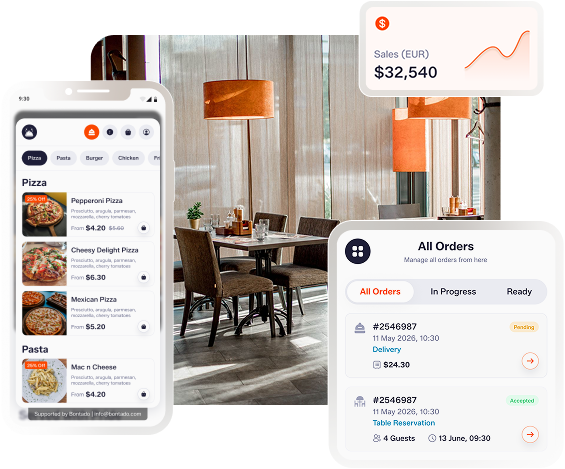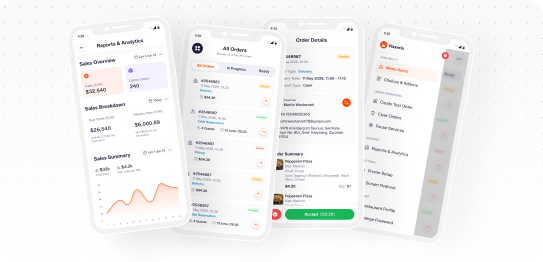
Launch your own branded ordering website, accept commission-free orders, and manage every order & reservation from one place.
Launch your own restaurant website where customers can browse your menu, place orders, and pay online—without paying marketplace commissions.
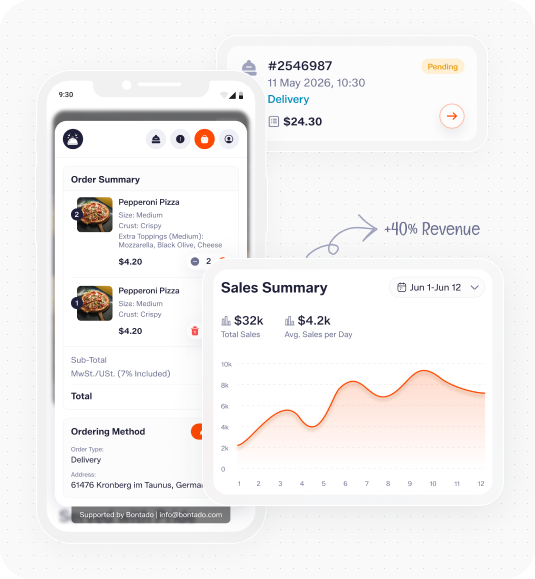
Manage orders, menus, customers, promotions, and reports from one simple dashboard designed for busy restaurants.
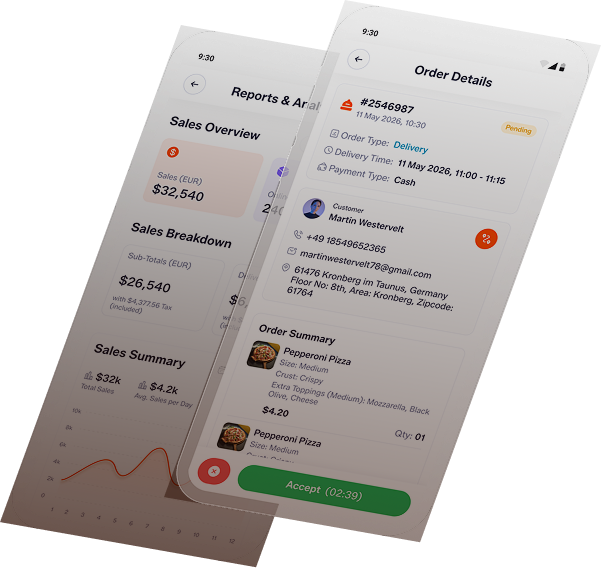
Accept, track, and manage incoming orders in real time from a dedicated app built for your restaurant staff.
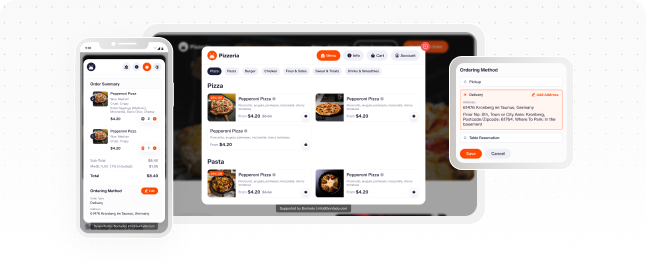
Take in-store orders, manage payments, and keep your online and offline sales perfectly in sync.
Manage campaigns & offers with full control
Take orders directly from social medias
Installable app experience without an app store
Track and manage every order in one place
Manage your delivery in real-time
Let customers browse your menu, place orders, and pay online through your own branded website—without paying marketplace commissions.
Learn MoreAllow customers to order ahead and pick up their food at a convenient time, reducing wait times and increasing order volume.
Learn MoreCustomers simply scan a QR code to view your menu, place orders, and pay directly from their phones.
Learn MoreLet guests reserve a table online 24/7 and manage bookings effortlessly from one simple dashboard.
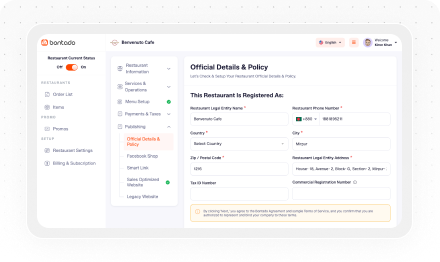
Learn MoreAdd your menu, business details, and preferences to get started.
Go live your website with online ordering, pickup, QR ordering, and reservations.
Accept orders, serve customers, and grow your direct sales.
| Features | POSPanda | Aggregators |
|---|---|---|
| Commission on Orders | Commission-free orders through your own website | High commission on every order |
| Your Brand Visibility | Fully branded ordering website | Customers remember that platform |
| Customer Ownership | You own your customer data | Platform owns your customer data |
| Pickup Ordering | Built in pickup or takeaway ordering | Limited support |
| QR Table Ordering | QR table ordering included | Not available |
| Table Reservations | Built in table reservation with ordering | Usually unavailable |
| Marketing Tools | Built in tools for Promotions & discounts | Limited marketing control |
| Menu Management | Update anytime - no restrictions | Delays & restrictions apply |
| Payments | Accept payments your way | Platform controlled |
| Repeat Customers | Build loyalty to your restaurant | Customers return to that platform |
| Reports & Analytics | Full business insights & analytics | Limited reporting |
| SEO & Google Visibility | Your website ranks on Google - customers find you | Their platform ranks - they own the traffic |
Have questions? We've answered the most common ones to help you get started with confidence.
Still have questions or need help setting up? Our support team is always ready to help you set up, learn, and grow with POSPanda.
Contact UsSteaming is widely considered one of the best cooking methods for preserving nutrients, especially water-soluble vitamins like vitamin C and B vitamins, since the vegetables aren't submerged in water where nutrients can leach out. Roasting and stir-frying at moderate temperatures are also good options, while boiling for extended periods tends to cause the greatest nutrient loss. Cutting vegetables into larger pieces before cooking and minimizing cook time also helps retain more of their nutritional value.
Gently press the avocado with your thumb near the stem — if it yields slightly to firm pressure, it's ripe and ready to eat. You can also check the small stem cap at the top; if it comes off easily and reveals green underneath, the avocado is ripe, but if it reveals brown, it may be overripe. A hard avocado that doesn't give at all is still unripe and needs a few more days at room temperature.
No, it's generally not safe. Perishable foods left at room temperature for more than 2 hours enter what's known as the "danger zone" (between 4°C and 60°C / 40°F and 140°F), where bacteria multiply rapidly. If the room is particularly warm, above 32°C (90°F), this window shrinks to just 1 hour. To stay safe, refrigerate leftovers promptly and when in doubt, throw it out.
Yes, in many recipes you can substitute butter with oil, though the ratio and result may vary. As a general rule, use about 3/4 the amount of oil as the butter called for, since oil is 100% fat while butter contains some water. Keep in mind that oil-based baked goods tend to be denser and more moist, while butter contributes more to flavor and a flakier texture, so the swap works best in cakes and muffins rather than delicate pastries like croissants.
A "best before" date indicates when a product is expected to be at its peak quality — flavor, texture, and freshness — but it's often still safe to consume after this date if stored properly. An "expiry" or "use by" date, on the other hand, is a safety indicator, especially common on perishable items like dairy, meat, and ready-to-eat meals, and food should not be consumed past this date due to potential health risks.
Most cooked leftovers stay safe to eat for 3 to 4 days when stored in an airtight container in the refrigerator at or below 4°C (40°F). After that, the risk of bacterial growth increases significantly, even if the food still looks and smells fine. If you don't think you'll finish leftovers within that window, it's best to freeze them instead, where they can typically last for 2 to 3 months without a major drop in quality. Always reheat leftovers to an internal temperature of at least 74°C (165°F) before eating.